Building this website’s platform comparison
Own-site project · WordPress · Interactive tools
This project was built for webdeveloper.tools. It explains a feature you can use here; it is not a customer project or evidence of business growth.
The problem
A platform name alone does not explain how a website will be edited, sell products, connect to other systems or be maintained. We needed a public comparison that showed those project responsibilities and let readers inspect the sources.
What we built
A native WordPress page compares WordPress, Shopify, Laravel and Wagtail across content editing, commerce, custom application features, hosting and maintenance, and integrations. Each of the 20 comparison cells links to official documentation. The copy describes different starting points and dependencies, without declaring a universal winner.
Optional JavaScript adds platform checkboxes, a requirement filter and a reset control. A status message reports the visible selection, and an empty selection explains how to recover. The complete semantic table is present in the page before JavaScript runs.
The interface
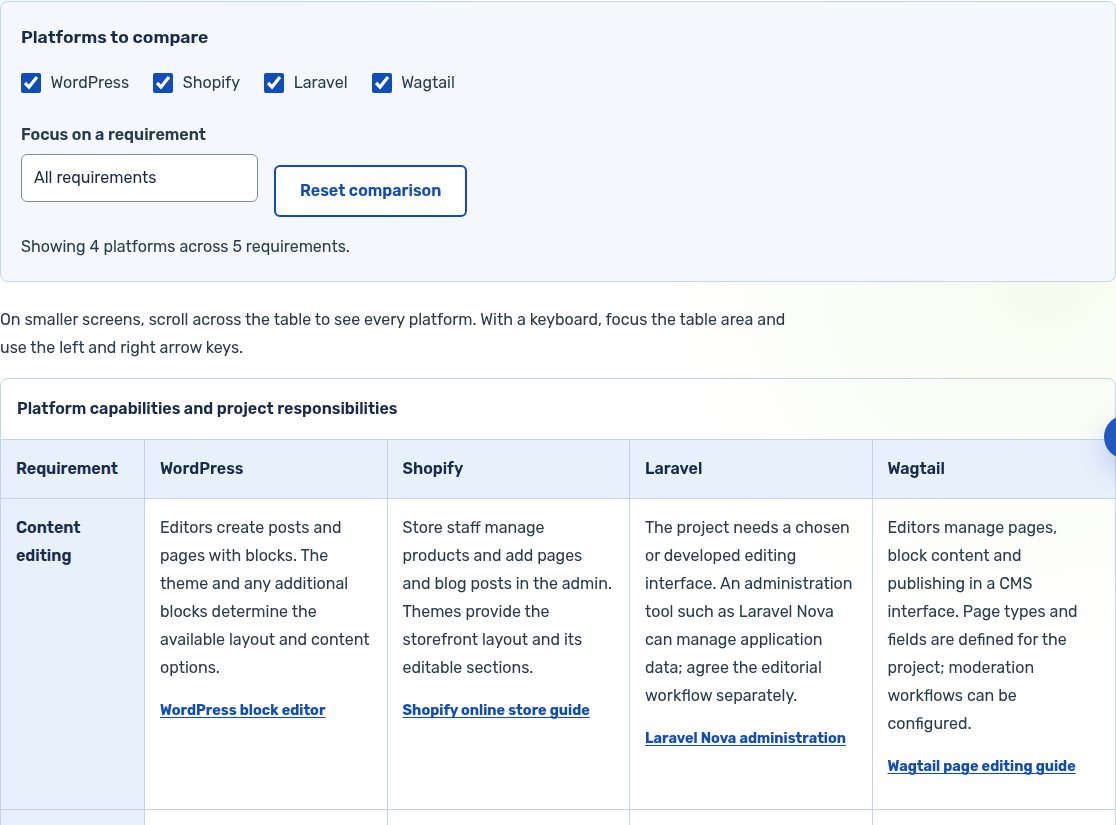
Use the live platform comparison to read all requirements and open the official sources. On smaller screens, the table scrolls within its own named region.
Observed results
- Native checks confirmed four platforms, five requirement rows and a source link in every comparison cell, with row and column headers connected to the data.
- Chrome checks changed platform selections and requirements by keyboard, restored the complete view with Reset, and recovered from an empty selection. The visible count updated with each state.
- Checks at 320, 390, 768 and 1280 px found that the page fit its viewport while the table retained horizontal scrolling. A 390 px check with JavaScript disabled retained all five rows and 20 source links, with the table region usable by keyboard.
What the evidence covers
These are repeatable native and Chrome interface checks recorded with this website’s implementation on 30 September 2026. They establish the checked structure and interactions; they do not measure traffic, conversions or a customer’s business results. The comparison does not replace a project-specific assessment, and platform capabilities or terms can change.
Explore the work
Try the comparison, read how the enquiry and support workflow was built, or discuss your website requirements.